

The £0 “Biohack” I Was Already Doing Without Realising It
The wellness industry hates this sort of thing

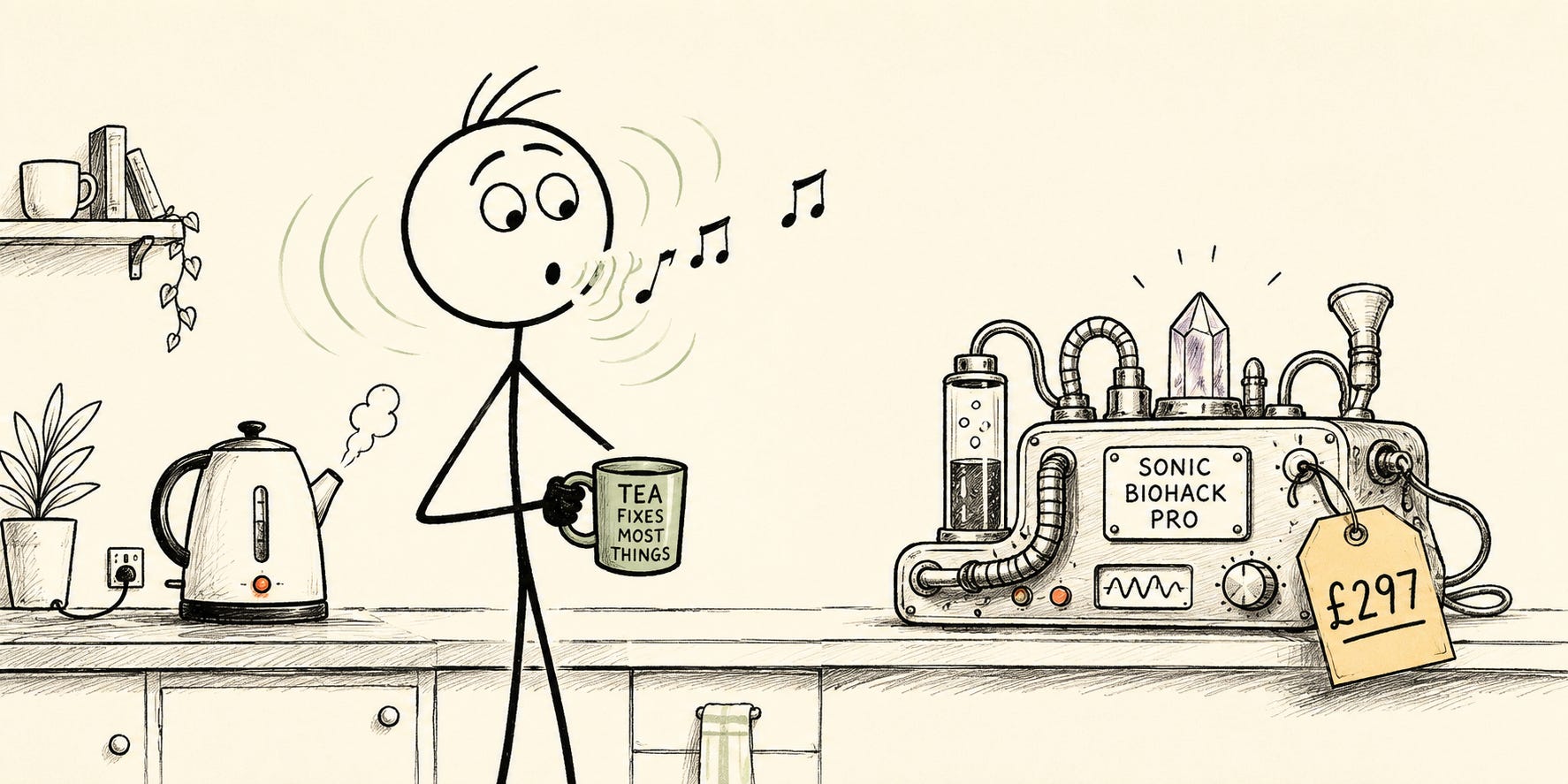
There’s a special kind of irritation that comes from discovering something you already do naturally might actually be good for you.
It’s annoying.
Deeply annoying.
Because you don’t get to feel clever.
You don’t get to buy a course.
You don’t get to order a Himalayan carbon-filtered anti-stress nostril-wand from some suspicious wellness man in linen trousers.
You just have to sit there and think:
“Oh. Right. So my body knew what it was doing before my brain got involved.”
Typical.
The thing I’m talking about is humming.
Yes.
Humming.
That thing you do while making tea.
That thing your nan probably did while polishing something no one asked her to polish.
That thing you do in Tesco when a song gets lodged in your head like a feral pigeon in a chimney breast.
Apparently, it might actually help calm you down.
Which is inconvenient, because it sounds stupid.
And I don’t mean “stupid” as in useless.
I mean stupid as in: “Surely my nervous system cannot be repaired by gently vibrating my face like a confused fridge.”
But here we are.
I’ve been humming for years
I hum all the time.
Not in a graceful, monk-like, “I have transcended the Wi-Fi password” kind of way.
More in a “something has escaped from my mouth again” kind of way.
Sometimes it’s rock.
Sometimes it’s metal.
Sometimes it’s country.
Sometimes it’s a random tune my brain has invented because it heard someone say something vaguely rhythmic.
Someone could say:
“Put the kettle on, John.”
And my brain goes:
“Put the kettle on, John.
Don’t be long.
Put the kettle on, John.”
And suddenly I’ve accidentally written a tiny musical about tea.
This happens more often than I’d like to admit.
I’ll hum Queen if I need a bit of theatrical emotional scaffolding. “Bohemian Rhapsody” is not exactly a cheerful topic, but the sheer drama of it makes your soul put on a cape.
Other days, it’s Linkin Park. Or Nirvana. Something with the emotional tone of a wheelie bin being thrown down a stairwell.
Because some days require angry humming.
Some days are not “softly hum like a bee” days.
Some days are “everyone can get in the sea, including the sea” days.
And then sometimes it’s country. Something softer. Something heartfelt. Something that makes you feel like you’re driving through a sunset even though you’re actually loading the dishwasher with the defeated body language of a Victorian orphan.
The point is: humming has always been there.
Not as a practice.
Not as a habit tracker.
Not as part of a 12-step morning routine with a glass jar and an accountability candle.
It just pops out.
And when I’m singing or humming to myself, I do genuinely feel happier.
Freer.
Less clenched.
Less like a squirrel trapped in a BBQ.
The problem with “calming practices”
Here’s my issue with most nervous system advice.
It sounds like homework.
And not even normal homework. Weird adult homework.
“Sit in silence for twenty minutes.”
No thank you. My brain has unsupervised access to the archive.
“Focus on the breath.”
Lovely idea, but now I’m thinking about breathing, which makes breathing weird, and now I’m convinced I’ve been doing breathing wrong for several decades.
“Perform this gentle humming practice like a bee.”
I tried this.
I really did.
And I get the idea.
You breathe in through your nose, then on the exhale you hum gently. Low and steady. Like a peaceful bumblebee that has done therapy and stopped dating emotionally unavailable wasps.
But I get bored.
Fast.
Within about twelve seconds my brain starts looking for exits.
The gentle bee hum becomes less “soothing vagus nerve exercise” and more “why am I making this noise, who signed off on this, and when can I stop?”
So yes, the controlled humming thing may be useful.
But for me, humming a tune works better.
A song gives my brain something to hold onto.
It stops the practice from feeling like I’m trapped in a wellness cupboard.
And because I enjoy it, I actually do it. I actually do it without thinking sometimes.
Which, irritatingly, is a fairly important part of any habit.
Why humming might actually work
Now, I need to be clear.
I am not saying humming will fix your life.
It will not pay your taxes.
It will not make your inbox less feral.
It will not stop a seagull from using your freshly washed car as a porcelain throne after a suspicious curry.
But it might help your body shift gears.
There’s some genuinely interesting science here.
A well-known study found that humming increased nitric oxide in the nasal passages by around 15 times compared with quiet exhalation. Nitric oxide is involved in blood vessel function and airflow in the sinuses, and researchers suggested humming may increase gas exchange in the nasal and sinus cavities.
That sounds fancy.
In normal human terms:
When you hum, your face pipes do things.
Scientific? Yes.
Elegant? No.
Useful? Possibly.
There’s also research looking at humming-style breathing practices and heart rate variability, which is often used as a marker linked to stress and autonomic nervous system regulation. One small 2023 study on simple Bhramari humming found changes suggesting greater parasympathetic activity during the practice.
Parasympathetic is the “rest and digest” side of the nervous system.
The opposite of “fight, flight, freeze, fawn, doom-scroll, eat crisps standing up in the kitchen.”
And then there’s the vagus nerve.
The wellness world talks about the vagus nerve like it’s a mystical garden hose of enlightenment. But stripped of the fairy lights, it’s an actual major nerve involved in communication between the brain and body, including the heart, lungs, and digestive system.
When people say humming “stimulates the vagus nerve,” the most grounded way to say it is this:
Humming combines vibration, vocalisation, and a longer exhale.
And long, slow exhales are generally associated with calming the body down.
So it’s probably not magic.
It’s mechanics.
Tiny, weird, throat-based mechanics.
The boring version versus the useful version
This is where I think a lot of advice goes wrong.
Someone finds a useful thing.
Then they make it sterile.
They strip out the personality.
They turn it into:
“Set a timer for 60 seconds. Sit upright. Inhale nasally. Exhale with a low-frequency vocal tone.”
Which may be perfectly valid.
But it also sounds like instructions written by a haunted printer.
For some people, that works.
For me, it makes my brain fold its arms and go:
“No.”
This is why I prefer song humming.
It gives the body the exhale.
It gives the face the vibration.
It gives the brain a tune.
It gives the mood a nudge.
And perhaps most importantly, it doesn’t feel like I’m trying to become a better person in public.
Because that’s exhausting.
Sometimes self-regulation doesn’t need to look like meditation.
Sometimes it looks like wandering around your kitchen humming an aggressive 90s rock song while waiting for the kettle to boil.
And honestly?
That feels more honest.
The mood bit matters
There’s another reason I think normal humming works so well.
Music changes mood.
This is not exactly breaking news.
Humans have known this forever. We sing at weddings, funerals, football matches, churches, protests, birthdays, and alone in cars when we think no one can see us absolutely butchering the high notes.
Research on singing has found links with mood improvement and stress-related biological changes. One study involving cancer patients and carers found that group singing improved mood and altered stress and immune-related markers, though the researchers were careful to say more work was needed.
Another pilot study found that both individual and group singing were associated with reduced cortisol, while group singing had stronger effects on mood and social bonding.
So when I say humming songs makes me feel happier, I’m not claiming to have discovered fire.
I’m saying my body seems to like rhythm, vibration, breath, melody, and emotional expression.
Which makes sense.
Because sometimes your brain doesn’t need another concept.
It needs a tune.
Sometimes the song tells you what you need
I also think the song that appears in your head can be a clue.
Not always.
Sometimes it’s just nonsense.
Sometimes your brain serves up the theme tune from something you haven’t watched since 1997 and refuses to explain itself.
But sometimes the song fits.
If I’m humming something theatrical and grand, maybe I need energy.
If it’s something angry, maybe I’m carrying frustration I haven’t admitted yet.
If it’s something soft and sentimental, maybe I’m more tender than I’m pretending to be.
This is where humming becomes less of a “biohack” and more of a tiny emotional weather report.
Not therapy.
Not diagnosis.
Just a little note from the internal Emo department.
“Hello. Today we are furious.”
“Hello. Today we are sad.”
“Hello. Today we require Queen and possibly toast.”
There’s something freeing about that.
Because instead of sitting there trying to mentally solve every feeling like a spreadsheet with childhood trauma, you let the body express something first.
A hum is low stakes.
It doesn’t need to be good.
It doesn’t need to be meaningful.
It doesn’t need to be posted online with a caption about your healing journey and a photo of your hand around a matcha.
It can just be noise.
Helpful noise.
The “deranged bumblebee” method
Now, I don’t want to throw the bee-humming version under the bus.
There is a place for it.
Especially if you’re overwhelmed and need something simple.
Here’s the basic version:
Breathe in through your nose.
Then hum gently on the exhale.
Keep it low and comfortable.
Feel the vibration around your lips, nose, cheeks, throat, or chest.
Repeat for a minute or two.
That’s it.
No incense required.
No need to levitate.
No need to say “mmm” like you’ve just been handed an organic cacao ceremony by a man called River.
Just hum.
The trick is not to force it.
You’re not trying to win Britain’s Got Vagus Nerve.
You’re just giving your body a longer exhale and a bit of vibration.
But again, if this bores you senseless, try a tune.
Hum something familiar.
Hum something ridiculous.
Hum something angry.
Hum something that makes you feel like you’re walking away from an explosion in slow motion wearing sunglasses you definitely can’t afford.
The best practice is the one you’ll actually do.
Annoyingly simple.
Horribly effective.
Rude, frankly.
Why this works for overthinkers
Overthinkers love a mental solution.
We want to think our way out of everything.
Anxiety? Think harder.
Self-doubt? Analyse it for six hours.
Burnout? Make a colour-coded plan.
Emotional discomfort? Open seventeen tabs and research supplements.
But the body often doesn’t respond to logic like that.
You can’t spreadsheet your nervous system into feeling safe.
Believe me, people have tried.
Sometimes your body needs a physical cue.
A breath.
A sound.
A walk.
A shake.
A stretch.
A song hummed under your breath while you pretend you’re not quietly losing the plot in aisle seven.
This is where humming is useful.
It interrupts the loop.
It gives the mind something else to do.
It brings attention back into the body without making a massive spiritual palaver out of it.
And because it’s portable, free, and socially survivable, you can use it almost anywhere.
Although I’d maybe avoid intense eye contact while humming in a lift.
There are limits.
My version of the experiment
I can’t claim some dramatic before-and-after transformation.
I already hum all the time, so it’s hard to say, “Here is the old me, tragically humless, wandering through life like an unplugged appliance.”
But I can say this:
When I sing or hum, I feel better.
Generally happier.
More relaxed.
More at peace.
Less boxed in.
The bee-humming version frustrates me if I try to do it for too long. I get bored and distracted, and then the whole thing becomes another task I’m failing at.
But song humming?
That works.
It feels natural.
Sometimes it’s deliberate.
Sometimes it just happens.
Sometimes my brain grabs a sentence and turns it into a jingle without permission.
And I like that.
Because not everything helpful has to be solemn.
Maybe your nervous system doesn’t need another “protocol.”
Maybe it needs a chorus.
The wellness industry hates this sort of thing
Probably.
Because you can’t really sell humming.
Not properly.
You can package it, of course.
Someone somewhere could absolutely create a £297 “Sonic Self-Regulation Masterclass”* with bonus modules, a printable tracker, and a man in soft trousers saying “frequency” too much. *(Note to self for future course content)
But humming itself?
Free.
Built in.
No subscription.
No affiliate code.
No need to wait three to five business days.
You already have the equipment.
Mouth.
Breath.
Mild willingness to look odd.
Done.
This is what I find funny about so many “biohacks.”
Half of them are just normal human things wearing sunglasses.
Walking.
Breathing.
Sleeping.
Sunlight.
Singing.
Eating food your great-grandmother would recognise.
Not staring into a glowing rectangle until your soul starts buffering.
We keep trying to upgrade the human body like it’s a laggy laptop.
But sometimes the factory settings are already quite clever.
Try this without making it weird
Here’s my suggestion.
For the next few days, don’t turn humming into a project.
Don’t make a chart.
Don’t buy a special notebook.
Don’t announce to your loved ones that you are entering your Humming Era unless you want them to move out.
Just notice.
When do you already hum?
When do songs pop into your head?
What happens to your mood when you hum them?
And when you feel tense, try one of two things.
Option one: the deranged bumblebee.
Inhale through your nose.
Hum gently on the exhale.
Do it for 30–60 seconds.
Stop before you hate it.
Option two: the internal jukebox.
Hum a song.
Any song.
Rock, metal, country, pop, something from an advert in 2004, whatever the noggin selects.
Don’t worry about whether it’s calming.
Angry songs can be calming in their own way.
Sometimes rage needs somewhere to go that isn’t an email written in all caps, or an elbow through a screen.
Sometimes humming something furious is the emotional equivalent of opening a pressure valve before the whole boiler goes full Victorian tragedy.
The point is not perfection
You don’t need to sound nice.
You don’t need to be musical.
You don’t need to “do it right.”
This is not about becoming the sort of person who owns a singing bowl and says “aligned” without irony.
It’s about finding tiny ways to come back to yourself.
That’s it.
And maybe humming works because it’s so basic.
It bypasses the performance.
It doesn’t ask you to explain yourself.
It doesn’t care whether you’re stressed because of work, relationships, hormones, money, the news, the algorithm, or because a seagull redecorated your car five minutes after you washed it.
It just gives you something simple to do with the body.
A sound.
An exhale.
A vibration.
A tiny rebellion against the noise.
Final thought
I like tools that don’t require me to become unbearable.
That’s my benchmark.
Does this help?
Can I actually do it?
Does it avoid turning me into someone who corners people at dinner parties to discuss nasal nitric oxide?
Humming passes.
It’s free.
It’s easy.
It’s weird enough to be interesting.
It’s normal enough to not require a personality transplant.
And for me, the song version is best.
The bee hum has its place, but I’d rather let my nervous system choose the soundtrack.
Some days it wants Queen.
Some days it wants Nirvana.
Some days it wants country.
Some days it wants to turn “put the kettle on, John” into a three-act musical with emotional depth and questionable rhyming.
Fine.
Let it.
Maybe your body is already trying to help you.
Maybe the little tune that pops out of your mouth isn’t random.
Maybe it’s your system saying:
“Here. Try this. You’re getting a bit clenched again.”
And maybe, just maybe, the quickest way back to yourself isn’t another book, supplement, app, tracker, retreat, protocol, or £400 gadget that looks like it was designed by a sleep-deprived dentist.
Maybe it’s a hum.
Ridiculous.
But then again, so are most things that work.